Finding My Stride

Saturday, June 27, 2026

I am learning—and in real time—about the profound difference between “doing exercises” and “moving with purpose.”

I’ve tended to be a cerebral type—happiest sitting with a book, dreaming of someday writing one. But as I age, things are changing rapidly. Much of what I experience today surprises me. Like, if anyone had told me earlier in life that I would someday be averaging something like 18,000 steps a day, I’d have laughed. Yet over the past several weeks, to my great shock, I have been stepping up to that entirely new rhythm—on my few acres and beyond.

Essentially, it’s about discovering a fitness routine that actually works for me. This one wasn’t designed by a gym trainer, but instead, by entirely different forces. It’s driven by a deep affection for animals, a strong sense of duty, and a love of the great outdoors.

This odd journey started with my longtime wish to correct some habitual “slumping” while standing and walking. Traditional methods led me to a competent personal trainer who guided me through structured, scientifically sound exercises. I struggled to keep up, but frankly, staring at a wall and doing isolated repetitions felt like a hollow routine. It offered no motivation.

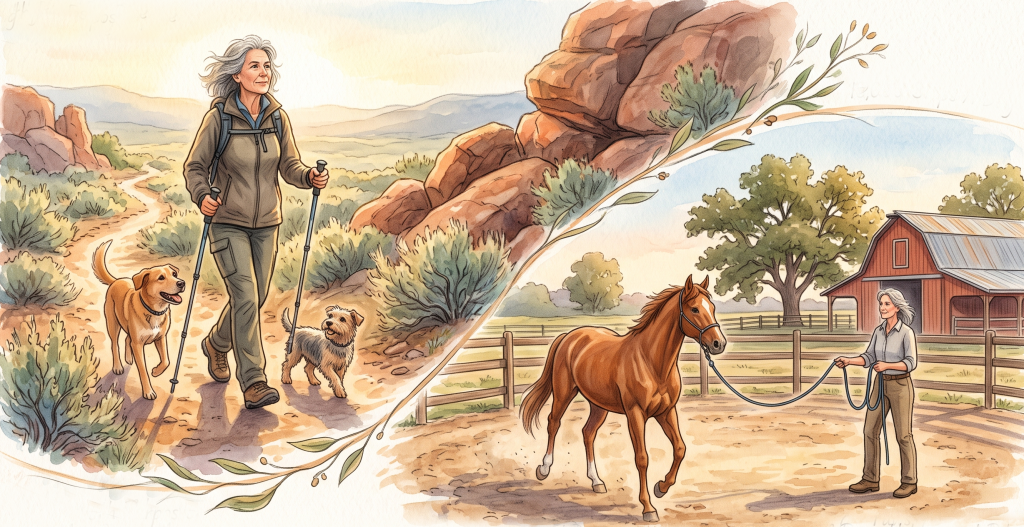
This summer finally arrived, and I began taking my dogs on outings at a nearby BLM. In this same beautiful weather, I also started working with my horse, Sunny, to recondition her for pulling a carriage. Quite by accident, the BLM trails and my own barn area have become daily highlights in my fitness evolution.

In the cool, early mornings, the dogs and I head out to a nearby Bureau of Land Management trail. Initially, we only walked half of the trail’s entire to-and-from distance, with my eyes glued to the dirt to dodge rocky protrusions. As my confidence grew, we started completing the trail’s full three-mile round trip. I was proud of us, and before long, I wished to push myself a bit further by adding a pair of lightweight hiking poles to our outings. Those poles caused an immediate shift.

Without the poles, walking had seemed too passive for my upper body—not offering enough to correct my old slumping habit. But adding poles changed the physics of my stride and gave me new hope. I could physically feel the planting of a pole and the pushing off. Those pulled my shoulder blades back, naturally opening my chest. The physical feedback encouraged me to work harder, with more hope of eventually standing taller without constantly having to force myself to “straighten up.” Those poles also give me the balance and confidence to work on lengthening my stride. Maybe they’re also helping to realign my spine.

The morning hikes are only part of the equation. Most afternoons, I’m out by the barn, lunging Sunny—asking her to trot steadily in circles for forty minutes. That’s not passive exercise; we’re a dynamic physical partnership. Managing twenty feet of lunging line requires a firm grip and forearm strength, and staying centered as Sunny circles me demands a stable, rotating core.

My horse doesn’t give a hoot about performance standards—she reads my body language perfectly. My “standing tall” in the center of our ring is a constant act of communication. If my attention wavers, Sunny senses it immediately, breaks her stride, and drops into a walk, forcing me to resume active participation.

Between those morning hikes with the dogs and the focused afternoon workouts with my horse, my daily step counts have skyrocketed. By the time the sun sets, my phone typically clocks me at 16,000 to 18,000 steps.

This is an incredible evolution. It’s teaching that my mind and body work best when they’re engaged together. Not long ago, the gym-style exercise routine felt like a chore, but now, there are early-morning hikes and focused afternoons with my animals that feel like life. These high-count steps will help me maintain health, manage weight, and focus on better posture. All these are vital gains—and best of all—achieved entirely on my own terms.

Instead of struggling to keep up with a rigid, repetitive exercise routine, it makes sense to consider trading the gym for what you really love. Step outside, find your purpose, and let the natural environment do the heavy lifting.

— Diana

This High Desert Summer

Wednesday, June 17, 2026

Finally, June has settled in. The mornings are warmer, crisper, and very clear. The daylight skies greet early risers with nearly impossibly beautiful shades of blue. And the neighborhood’s wildlife is suddenly making more demands for attention. Most recently, in the early mornings, my coffee is frequently interrupted by new, highly vocal bird sounds.

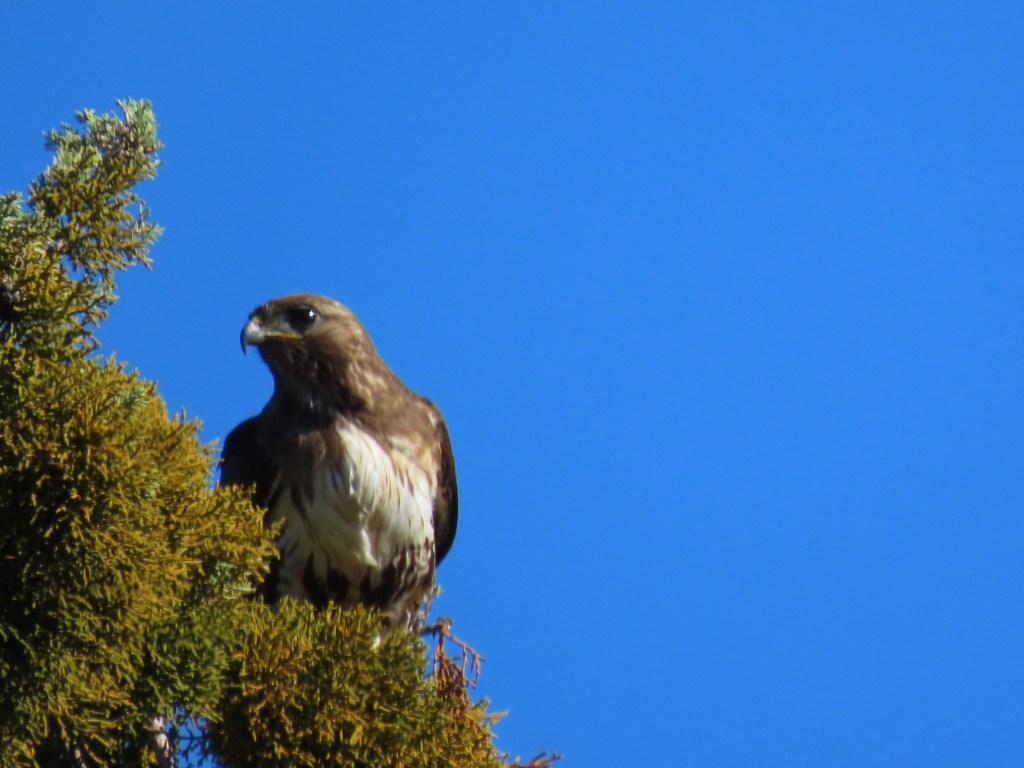
Lately, those sounds have drawn me outside. I look up high and far around to locate their source, finally focusing on the tallest surrounding juniper tops and the open sky. I quickly started taking a camera on my early trips outside, to listen and look—for glimpses and images of our newest local resident: a magnificent Red-tailed Hawk.

For days, that striking raptor has been perched atop several of my tallest trees. It stays in place while highly visible for long periods. That bird usually isn’t quiet, and so, it’s likely a juvenile. This is the season when young hawks fledge. Their relentless, raspy screams insist on (something like): “Mom! Dad! I’m hungry, and I’m here, waiting!” Young hawks testing their boundaries are still entirely dependent on the parents. This particular local noisy youngster vividly demonstrates a fledgling’s sheer patience—sitting, staring intently at the ground, crying for attention…and waiting.

To me, seeing this is like witnessing a masterclass that highlights the focused, solitary, and fierce nature of raptor life.

Of course, curiosity led me to research, where I learned that, like most other raptors, Red-tailed Hawks are monomorphic —meaning that males and females share the exact same plumage, coloring, and patterns; no distinct feather-color markings set them apart.

My local resident’s gender will always be a beautiful high-desert mystery!

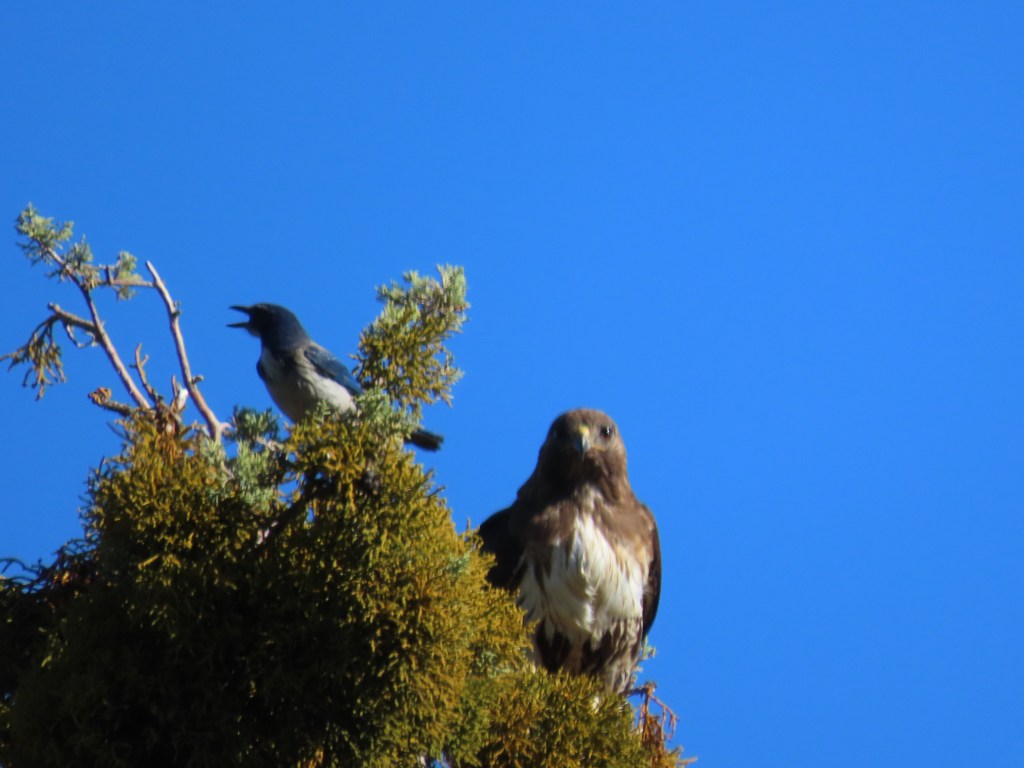
In one of my more interesting photos, a (protesting?) California Jay (formerly known as a “Scrub Jay”) appears positioned uncomfortably near the Red-Tailed. What a contrast, for if this jay happens to be worried about its own nearby nest, that focused hawk couldn’t care less.

These days, in another big part of my birding routine, I’ll lift my sights higher, trying to sense way beyond the juniper tops, the mountain air currents. Sometimes, luckily, I’ll find myself witnessing completely different bird behaviors—and actually another form of masterclass—this time, seeing an adult-juvenile summer school in session.

Featuring others of our local residents, the ravens, way up there. Teaching their fledglings!

The young hawk I am enjoying represents a more solitary, focused species. In contrast, the active raven family represents pure, cooperative joy. There’s little as beautiful as the ravens—riding, gliding on thermal drafts—flying and playing. Parents guiding their young through wind’s invisible circles—practicing floating effortlessly, making sudden stalls, and sudden acrobatic tumbles—vividly acted against the big blue. Those birds’ sheer intelligence radiates as the fledglings mimic the adults—learning the physics of the sky. It’s a program of sheer curiosity and aerial dancing.

In this wonderful time of year, Central Oregon offers front-row seats to these and other fascinating bird worlds. Here, beside my home, on a high treetop perches a young predator—a perfect combo of intensity and impatience—working to find its footing. And higher above, in the wide open air, brilliant and socially complex corvids are mastering the winds.

Yes, in summer, all that’s local becomes very much alive. There are squawks and screams drawing attention to glorious raptors. And there’s sky-watching that brings sheer joy in seeing other fabulously intelligent birds working their magic.

Yep, summer’s here, finally.

— Diana

A Team Of Two

Friday, June 12, 2026

A month has passed since my mare, Rosie, died.

Rosie was Sunny’s big sister. They shared the same parents and also enjoyed a long partnership with me. Rosie was the boss mare, the decision-maker, the horse who always seemed to know where we were going and, quite clearly, had opinions about what we were doing. Sunny was content to follow Rosie’s lead. For years, that arrangement worked well for all of us.

Then suddenly, it didn’t.

After Rosie was gone, I found myself facing a practical question about horses as herd animals. Should I find another equine companion for Sunny? At my advanced age, is it sensible to take on another animal? Or, better yet, could I find ways to keep Sunny active, engaged, and interested in life as a solitary horse?

I chose the latter, at least for now.

Sunny is twenty-two years old. She is healthy and appears sound. She and I have established a routine. Each day, I lunge her at a trot, changing directions every ten minutes, for a total of about forty minutes. Afterwards, she receives her reward: time on grass or other small freedoms that she clearly enjoys. I’ve also been riding her, though only at a walk. Because I’m focused on maintaining my own balance, she carries me patiently and without complaint.

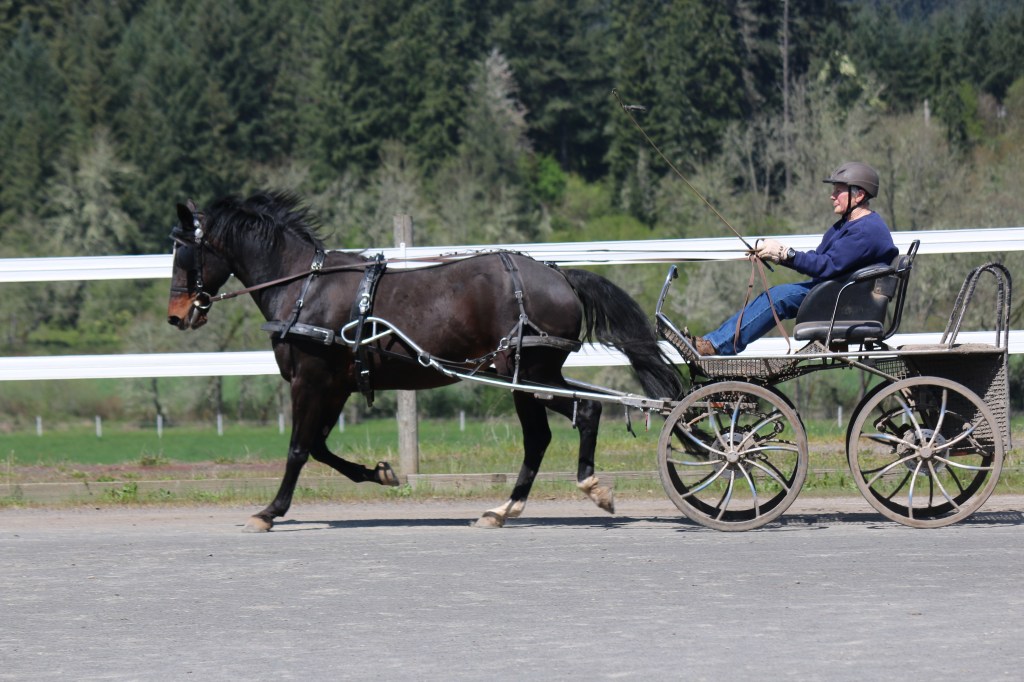
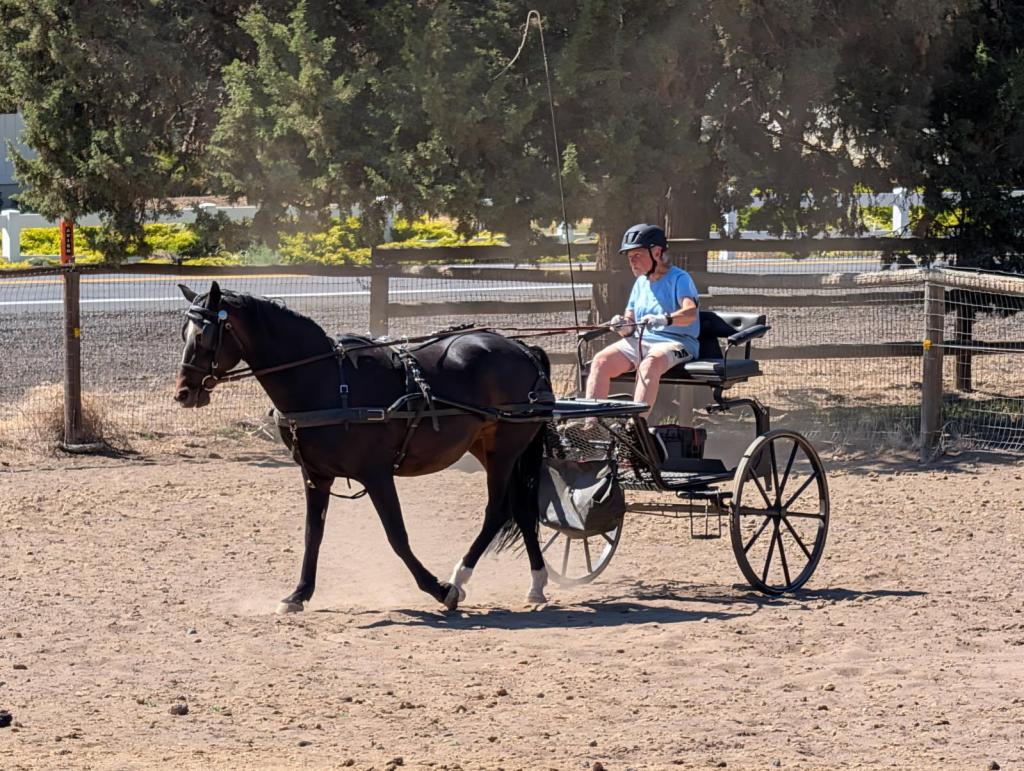
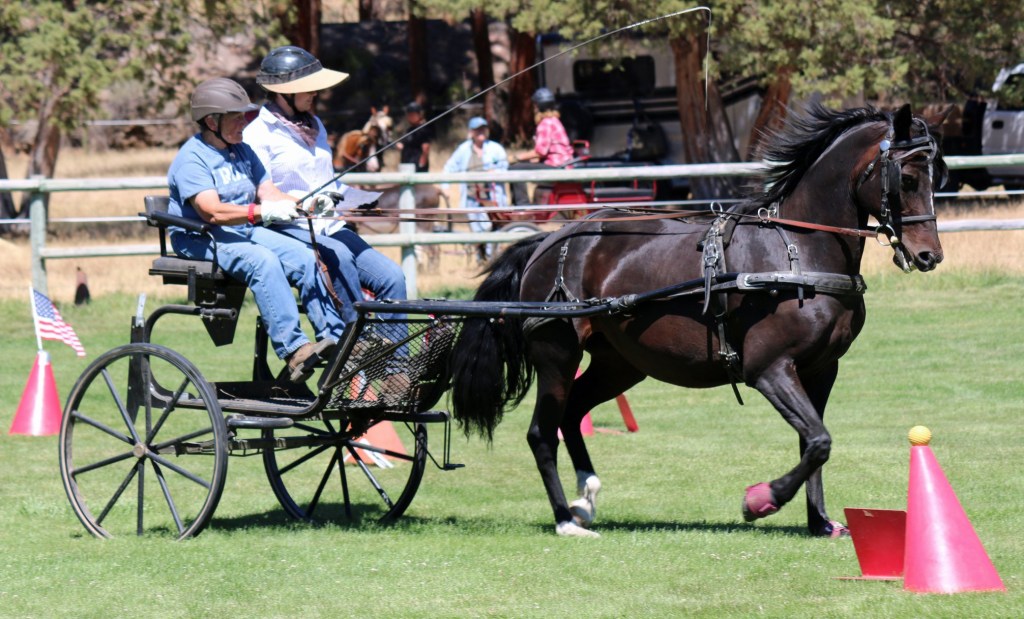
I’ve hoped we could start driving again. But Sunny hasn’t pulled a carriage in about four years. Before considering a return to driving, I asked my veterinarian to evaluate her. He watched her trot on a lead line and then observed her on the lunge. He also knew Sunny from years ago, which added value to his assessment. His conclusion was encouraging. He found her doing well and started her on Adequan, a medication intended to support joint health.

Something unexpected has happened during this month of working closely together.

Sunny is paying more attention to me.

Perhaps that’s because Rosie is no longer here to command her attention. For years, Sunny’s world revolved around the older mare. Now, she looks to me more often. She seems more responsive, more connected, and more interested in what we’re doing together.

Our next step will be returning to driving.

Before that can happen, Sunny will be shod. Then we’ll begin slowly in the dry lot. Fortunately, my lot is large enough that we can make repeated circuits amounting to several miles if we wish. There, we can regain our confidence without worrying about traffic or other distractions.

And confidence is something we both need.

The truth is that Sunny may remember driving better than I do. I’m finding that I remember the broad outlines, but some of the details have become hazy. Harnessing. Hitching. The order of straps and buckles. Those little habits once seemed automatic after years of repetition. Time has a way of quietly letting such things slip away.

The dry lot will allow me to relearn my side of the partnership while Sunny relearns hers.

Eventually, if all goes well, we’ll venture through some of my neighbor’s property and out onto the neighborhood roads. We’ll drive a familiar three-mile loop that we traveled many times in years past. It’s a relatively quiet route, though today’s drivers don’t always expect to encounter a horse and carriage on the road. We’ll proceed thoughtfully, and fortunately, we needn’t be in a rush.

Over the last month, I’ve come to realize that these efforts are about more than exercise. Certainly, driving will strengthen Sunny’s muscles. It will strengthen mine as well. Yet something deeper is taking place.

Over the past year, my donkey’s adoption by a neighbor and Rosie’s death have emptied spaces in my little herd, leaving Sunny alone. Horses are herd animals. The obvious solution was to fill that empty space immediately with another equine—or perhaps some other animal that could serve as a companion.

Instead, Sunny and I are discovering what life looks like as a team of two.

At twenty-two, Sunny doesn’t need a demanding career. Neither do I. What we both need is purpose, routine, and the satisfaction that comes from doing things together.

So we’re beginning again, one careful step at a time. What’s most reassuring is knowing that neither of us is starting from scratch. From somewhere beneath the years, Sunny remembers her job. And with a little practice, I’ll remember mine better, too.

– Diana

What Fits Now

Saturday, June 07, 2026

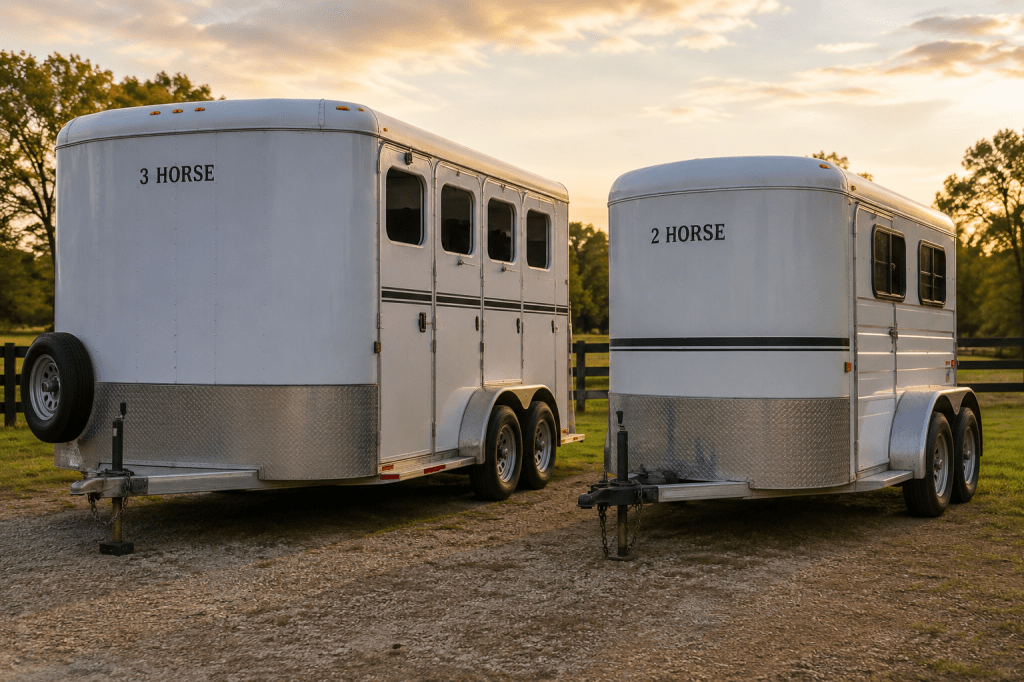
My large three-horse trailer has long been perfectly sized for my needs. That’s because my horses, Rosie and Sunny, and our donkey, Pimmy, often traveled together. For many years, I’d ride one horse and pony the other, while Pimmy, who adored her horses, followed along untethered. We were a small trio heading down trails and country roads. I don’t remember thinking those perfect days could end.

But they did—as all seasons eventually do. Things for me have changed, and quickly.

Rosie crossed the Rainbow Bridge this spring. Pimmy, now elderly herself and needing daily medication, has gone to live with a younger neighbor. A donkey can live to be forty years old, and her new person can promise care for as long as Pimmy may need it. Sunny remains here with me. She’s a sweet 22-year-old, small and technically a pony. As a side note, Sunny is also Rosie’s full sister.

During our many years “of three,” I had little reason to use my other trailer, a smaller two-horse Logan. Why switch trailers? Why train the horses to a smaller trailer when the larger one comfortably carried the entire crew? So I let the Logan sit and time slipped away. Its weatherstripping gradually loosened. Tires aged. Dust accumulated.

This week, with only one horse remaining, I started seeing the big three-horse trailer differently. Now, it’s much larger than Sunny needs. I decided it was time to inspect the Logan and assess what’ll be required to put it back into service.

At first, refurbishing the Logan seemed simply a practical matter—replacing seals, checking tires, and making a few minor repairs. But as I stood and looked at my old trailer, something within me began to shift, and it occurred that maybe I was seeing something more.

I felt more aware of changes affecting my small property, and that seemed to influence how I saw. My smaller trailer stopped representing less. Instead, it began representing what fits now.

I almost physically felt changes in my daily life. For the first time in twenty years, I had only one large animal to care for. That meant more time for me to slow down, more opportunities to tackle small waiting tasks, and more room for quiet moments with a book.

All new realities require appropriate attention and time. Sunny has needs—deserves adventures. We’ll always need a horse trailer, but now the smaller Logan is right for carrying Sunny. Besides trail rides and visiting friends, if she ever needs veterinary care, the Logan has a loading ramp, making it easier to transport her. I now see that old trailer as having many useful years left.

I also understood that the Logan trailer isn’t the only thing around here calling for refurbishing. Sure, Logan needs weatherstripping, tires, and an overall inspection. But I’m here, too, and, oops—I need something similar—another version of refurbishing. I must keep in my sight an ongoing need to adjust my perspective on the world. Right now, it’s about my changing world—containing one equine instead of three.

My broadening awareness feels quietly reassuring—reminding me that life does continue. And that we’re capable of adapting and finding ways forward—although our daily lives may be reshaping in ways we’re not ready for.

— Diana

The Way Back To The Jeep

Rachelle’s past much-loved pal, her Nova Scotia Duck Tolling Retriever (named Bon Jovie).

Saturday, June 06, 2026

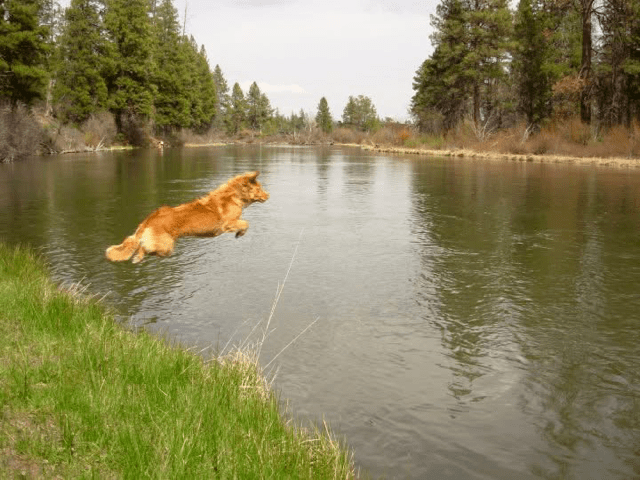
My dogs and I love a nearby BLM area for many reasons. For one thing, it has a long irrigation canal with rushing water, lined with colorful wild water lilies. We were there recently to meet up with our longtime friend, Rachelle, who brought Ryder, her beautiful Aussie. He and my Chase are vigorous play buddies.

Rachelle and I hadn’t walked with our dogs for many months. We’ve been busy, so we had lots of catching up to do. And we did, while walking along the path beside the busy canal as our dogs played, chasing one another into and out of the water.

Rachelle is a lovely companion—bright, well-informed, and creative. Years ago, during one of our walks, she encouraged me to explore podcasts. I did, and found myself enjoying the timely perspectives of favorite writers and newscasters. Recently, I graduated from podcasts by subscribing to YouTube Premium, which is now my go-to source for news and commentary. Rachelle said she, too, pays close attention to that platform.

We were in sync, walking, talking, and sharing thoughts about our strengths, weaknesses, and changing physical and mental energies.

I am aging and thus paying more attention to matters of aging, with mixed delights and worries. So, walking and talking with Rachelle is special because she’s open, honest, and insightful. While she’s younger than me, Rachelle understands many of my concerns about what may lie ahead in the unstoppable process of aging.

She told me that she had recently been deeply involved in one of the most sensitive issues associated with aging. Her mother, Fay, who was more than 100 years old, recently passed away—by Fay’s own choice and with medical assistance. Rachelle said the actual event was a peaceful ending. (Note: Rachelle has given me permission to write about her mother.)

Fay’s early history dates back to the 1920s, and I asked about it. Rachelle said that her mom had found her way into college, earning two degrees, a Bachelor’s and a Master’s, during years when women typically did not do so. After finishing college, Fay began teaching in the New York public school system. She continued there until retiring at age 59.

From a genetic standpoint, Fay’s genes were remarkable. Rachelle probably has inherited some of those advantages. Perhaps I have them, too, as my own mother lived to around 100. We were never entirely sure of Mom’s age because she was born into an immigrant family in America and had no recorded birth date. She estimated her birth year, but whether she was accurate or not, she was certainly long-lived.

Rachelle explained that Fay actively participated in choosing her method of death. That decision was made several years earlier, while Fay was more cognizant of the realities of aging. Rachelle and her brothers supported Fay’s choice. Rachelle filled a prescription and stored it for use when the time eventually came.

Next year, Rachelle’s brothers, who live in other cities, will join her to spread Fay’s ashes.

Meanwhile, our dogs were having a wonderful time, but an underlying worry nagged us. I had brought along Osix, my 15-year-old Border Collie mix. Physically, Osix remains active and strong, but she has lost 80 to 90 percent of her hearing and has developed cataracts, which have impaired her vision. These days, I take Osix only to trails she knows well, thinking that if she gets confused about where she is, she will still remember where my vehicle is parked.

Just in case, I had brought the dogs in my old, familiar Jeep, and at the BLM, after releasing them to run, I left the cargo door open. Somewhere along our walk, upon realizing that Osix had disappeared, Rachelle and I were concerned. But we remained cautiously confident that Osix could find her way back to the vehicle.

Upon finally returning to the parking area, we saw Osix waiting patiently in the Jeep’s cargo area. Yet, I sensed a bittersweet note in the moment; for that may have been my old dog’s last opportunity to roam freely in such wide-open spaces. Although I hadn’t spoken much about this, a worry in the back of my mind was what I’d do if it were necessary to search for a lost Osix in that vast BLM landscape. It was a tremendous relief that she remembered her way back to the Jeep.

Rachelle and I are planning another dog-walking outing in a couple of weeks. With more pleasure, good conversation, and mutual appreciation ahead for ourselves and our dogs.

— Diana

Under Her Wings

Saturday, May 30, 2026

Domestic chickens are arguably the underdogs of the pet world. Tiny chicks need coddling until they’re fully feathered and able to keep themselves warm. After that, they’re turned loose in an enclosure—or allowed to free-range. The point of keeping chickens, of course, is getting eggs. There’s little as pleasing as farm-fresh eggs—standing up in a skillet, smiling, and, by most accounts, tasting better.

I could babble on about fresh eggs, but my real purpose here is to talk chickens—or rather, one chicken. Specifically, a single hen.

A Welsummer was her breed, and “Welsummer” became the name I casually gave the little chick who joined my first flock back in 2010. I purchased her, along with two bantam chicks, when they were about two days old. They had been placed in a “sick tank” at the feed store and needed special care. I paid 50 cents apiece for them.

I remember wondering, “What’s a Welsummer?” I later learned it is a Dutch breed of mixed ancestry, developed in farmyards during the early twentieth century.

At home, I found an unused terrarium, added bedding, rigged an overhead heat lamp, and settled the tiny chicks inside. As small as Welsummer was, the bantams were even smaller. What I witnessed was lovely. Each bantam hopped over to Welsummer and tucked itself beneath one of her wings. There she stood—patient, accepting, and hardly bigger than the chicks she sheltered.

I was looking at a chicken, and yet, was mightily impressed. I never forgot such kindness. That trio’s behavior continued until the babies grew stronger and more confident. Eventually, all three joined the larger flock.

Fast forward about ten years. By then, every member of my original flock was gone except Welsummer, who still wandered the enclosure. I brought home a new batch of chicks, raised them until they were feathered, and then turned them loose with the old hen. That was before I understood the importance of properly introducing unfamiliar chickens.

The youngsters and Welsummer were not going to get along.

Welsummer had outlived a great many chickens, and I wanted her safe. So I moved her into a special pen with a heat lamp inside my attached garage. There she would remain protected for as long as she lived.

That was nearly six years ago.

Sadly, yesterday, Welsummer—once the kindest little chick I had ever known, and later my beloved special pet—crossed the Rainbow Bridge.

She was turning sixteen years old. A remarkably long life for a chicken.

— Diana

What Friends Are

Friday, May 29, 2026

I had another birthday this week. I’d prefer to forget that this is my 86th year, but so it is. Longtime friends reminded me all week with cards and phone calls. On the actual day, Eva and I met for lunch and discussed activities and issues in our lives.

And then, there were Susie and Dale. Just when I’m not caring much about celebrating another year, Susie steps in.

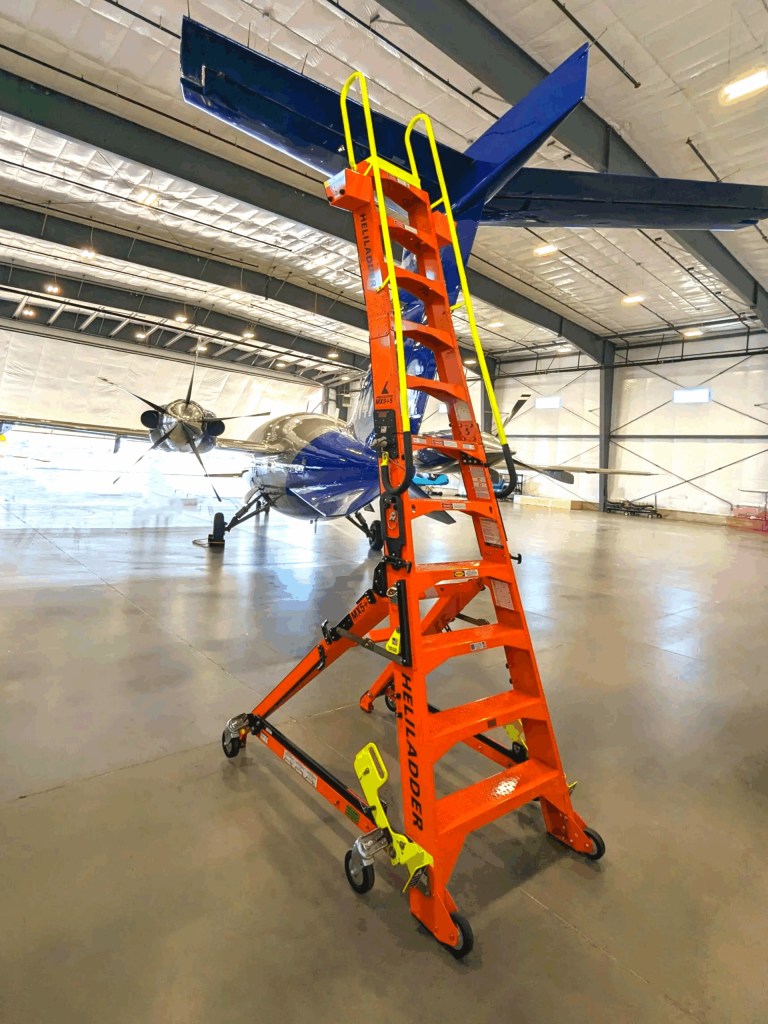
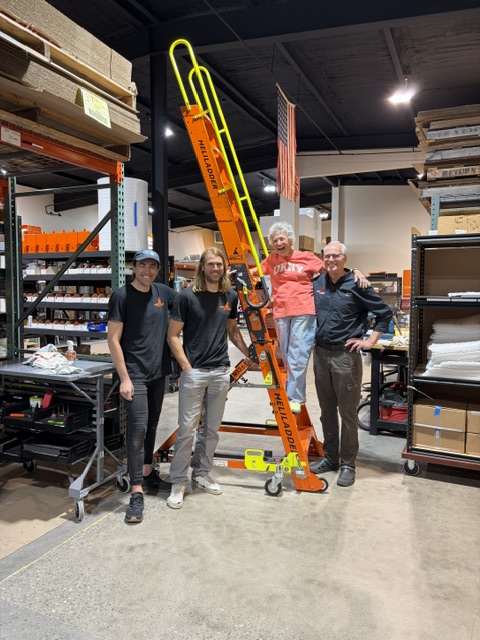
She’s big on relationships, big on caring, and big on birthdays. So is Dale, who stays busy managing his business — his brainchild and creation — HeliLadder. Which, by the way, now occupies a building of its own in this city’s key industrial district. (More about HeliLadder later, in an upcoming blog, as I’ll soon visit to see its new digs for myself.) But, for now, I digress.

Yesterday evening, on a very rainy day, Dale and Susie hosted a birthday dinner for me. We went to the Pine Tavern, this city’s oldest restaurant — a delightful place — where Dale had ribs while Susie and I dove into gigantic hamburgers, a rare treat for this “casual vegan.” Afterward, we took our desserts back to Dale and Susie’s, where we lingered and talked late into the evening.

I’ve reached a time in life when relationships matter more and more. I’ve never been especially skilled at handling meaningful relationships, for complex reasons, though I’ve forgiven myself for that. I filled many years of my life with beloved pets and, later, horses, which always kept me busy and physically strong. While I’m generally content with the life I’ve chosen, it feels like a mitzvah to have met Susie and Dale — people with whom, over time, I’ve become comfortable and can freely “be me.”

So Susie made certain they shared my birthday. And, in a rare experience for me, they asked for details about my background and listened — without judgment — to my complicated story.

Their kindness has helped me better understand what it means to be a friend. Friends “are there,” unafraid of getting involved, supportive of others’ choices, yet willing to push back, ask questions, and perhaps influence a decision-making process. But whatever decision ultimately prevails, they remain — listening, encouraging, and supporting.

For someone who has always been careful about relationships, they are among “the best” for where I am in life now. They help keep me anchored to occasions, events, and sometimes delights. Speaking of which, Susie and I plan to head east next Sunday night “to chase” the rising Blue Moon.

Punctuating a mature Ponderosa inside Pine Tavern’s Main Dining Room

The best part of my special day was simply this: people who genuinely care “were/are there,” even while busy with lives of their own.

— Diana

Bend’s New Library – Revisited

Tuesday, May 26, 2026

I was excited on my first visit to this brand-new building not long ago, but I became disappointed when I found it wasn’t the kind of “real library” I was accustomed to. A day or two later, I reflected on how the structure is actually meant to be used. Certainly, it will be a popular meeting place — and already is — with its huge, nearly always full parking lot. Still, it wasn’t like the libraries I understood and had known. I left the building with a sense of loss.

Now I see things differently. At first, I was deeply wrapped up in myself and wanting what I expected. Later, my outlook began to recover as I reflected on the larger picture — the social changes that influenced the library’s design and purpose.

I was flummoxed to discover that the building primarily serves as a community gathering space. Although books on display hint at a traditional library, with well-arranged shelves holding the newest and cleanest volumes, they don’t fully counter the sense that the building functions mainly as a hub. Cardholders can go online, search for and reserve desired items, then simply pick them up. A dedicated drive-through even facilitates quick pickup and return of library materials.

Yes, social media and AI have changed our relationship with libraries. Online access makes things easier and reduces the physical need to wander through stacks or seek assistance from librarians. Libraries are adapting by becoming less centered on book browsing and more focused on serving as multi-purpose community spaces.

That realization had me reflecting on my part-time job as a department store cashier. During breaks, coworkers rarely talk with one another. Instead, we stare at our phones — and, personally, I usually prefer not to be interrupted by someone wanting to chat. Not only at work, but also out on city streets, people are absorbed in their phones.

Yet while I check out customers, many seem delighted to share parts of their lives with me — stories about their backgrounds, travels, pets, and adventures. Some even say they’ve appreciated our brief exchanges, and occasionally someone jots down a phone number and suggests I get in touch.

Those brief getting-to-know-you moments are enjoyable, but somehow they feel sufficient in themselves. I don’t follow up. Still, I sometimes think I might enjoy knowing some of those people better, as many clearly have unique backgrounds, interests, and accomplishments. And if we happened to meet in a non-work social setting — perhaps in that new library building — getting to know one another more deeply might seem more natural and appropriate.

On this second visit, I’m not searching for books. I’m simply enjoying time in an enabling space while drafting this blog. No pressure, no disappointment. I’m sitting beside a large window, feeling creative — and communicative — while occasionally accessing social media myself. Nearby, other visitors are taking similar advantage of the space, working on studies or staring into laptops and cell phones.

This library — designed for meetings and work as much as for books — serves as an alternative to the popular coffeehouse. One can leave home with a laptop and come here to sit, think, and spend time among others in a non-demanding social environment. And there’s even a handy coffee bar.

I’m giving this new library building a great deal of slack. A modern community needs people-friendly spaces — and certainly more spaces like this one.

— Diana

Beautiful Rosie

Monday, May 15, 2025

This year, Rosie turned 30. Yesterday, she crossed the Rainbow Bridge.

She was a Foundation Morgan, which meant her pedigree traced back to the original Morgan horse, “Justin Morgan.” Her paternal grandfather was a famous Morgan named Promise, whom she physically resembled. Rosie came to live with me in her late prime—around 15 years old. She had been trained as a carriage horse, and I hoped to learn that sport.

Rosie went to a capable trainer to be physically reconditioned and refreshed for driving. Meanwhile, I took driving lessons. Soon, I learned to drive my flashy mare, and we became a fine team. Lovely Rosie was also built beautifully for riding, and together we traveled many trails through nearby mountains and forests.

She was a true boss mare—the Queen of the Paddock—over Sunny, her accommodating stablemate and younger full sister. Rosie was special, with her own peculiarities. Her distinctive personality and style taught me how to partner well with a sensitive horse.

Last night, Sunny and I deeply missed Rosie’s usual strong presence. We will miss her again today—and for many days to come.

RIP, our Beautiful Rosie.

– Diana

Bend’s New Library

Saturday, May 16, 2026

Yesterday, I sat in a “creative cubbyhole” beside a large window with my laptop in our new main library. It opened earlier this week, and inside it is beautiful—spacious, light-filled, modern, and carefully designed. Yet, surprisingly, as I looked around, I found myself missing this city’s old, now-closed main library. That crowded old place felt less curated and more discoverable.

Almost as soon as I entered the building, I began comparing what I saw to the old library’s stacks, which had always seemed endless. I recalled the faint dust-and-paper smell of well-used books and remembered running my index finger along crowded spines—often stumbling upon a surprise: a long-forgotten title, a long-unread author, or an unusual and compelling subject.

Central Oregon is full of readers. We’ve all been curious about this ambitious building, watching it rise and eagerly awaiting its opening. All week, visitors have filled the library, circulating among its attractively displayed shelves. But to me, the shelves feel too tidy, almost merchandised. Shiny book covers face outward in displays that seem heavily edited—perhaps too intentionally curated. Titles are visible, but authors’ names are partly obscured by catalog stickers.

Those displays push the curating system itself into the foreground, suggesting that organization matters more than browsing. I was surrounded by clear, clean order that somehow didn’t feel intimate. I assumed any book I wanted would be available and easily accessible, yet something essential felt absent.

While sitting there yesterday near the large window, I noticed the blinds lowering automatically in response to the changing light outside. I would call the library beautiful in the way airports and modern museums are beautiful: open, bright, efficient, and almost impossible to criticize directly.

The building even includes a first-floor coffee bar. One can order a designer coffee, settle beside a window to work or study, or simply linger over a latte. The interior design encourages community and socialization—a kind of environment I usually enjoy—but it is not quite my idea of a real library.

I found myself reflecting on the libraries of my childhood, my young adulthood, and my more recent past, remembering their narrow aisles and accidental discoveries. What returned most strongly was the feeling of books aging together in those old spaces. There, books were encountered almost physically: by touch, by proximity, by scent. In this modern setting, the books feel staged. There is more emphasis on display than discovery.

Old libraries invited wandering, browsing, and sampling. This new facility is designed for ease of navigation. Perhaps this very modern library optimizes access to materials. But a better building does not necessarily feel like a better library.

Essentially, it functions as a hub. Someone seeking a book, movie, or other item from the library’s non-visible holdings goes online, searches the catalog, and reserves the desired materials. The items are then picked up and returned at the building.

And yet, it is undeniably seductive. Imagine a Starbucks on steroids. Someone—maybe me—can walk in with a laptop, order a latte with an extra shot of espresso, settle beside a large window, think, create, and perhaps even meet new friends.

Diana